NICE syndication API
Embed our content in your products and services.
Available content
Subject to agreement, you can use our syndication service to access all our guidance, including quality standards and information for the public.
Content not available
Clinical knowledge summaries are provided by Agilio Software, please contact them directly to access their content API.
British National Formulary content is available for syndication through its own API. This is subject to criteria and technical specification.
Who can apply?
The NICE API is available for use by companies and organisations, not private individuals. UK based students can access the API for research by applying with the consent of their university who will need to sign the licence and comply with the cyber security requirements.
Organisations must hold cyber security certification to access the NCE API. The following forms of certification are currently accepted:
Cyber essential plus
ISO27001
NHS Data Security and Protection Toolkit (for public sector bodies in the UK only).
We will consider different forms of certification for companies applying from outside the UK, please state these in your application
Can I use Artificial Intelligence on NICE content?
Yes, you can use artificial intelligence (AI) on NICE content accessed through the API. This is subject to NICE approving your application and how you want to use AI and issuing a licence.
State how you want to use AI on NICE content in your application form. The use of NICE content to train AI models in not permitted.
How it works
Syndicated content is provided through an application programming interface (API).
If your application is accepted, you will receive a unique API key. This provides access to NICE content for use in the specific services set out in your licence.
Someone with technical knowledge will need to integrate the API key with your platforms and systems. Our user guide will help you get started.
NICE syndication service and application programming interface (API) guide.
Licences
All requests to use our content via the syndication service will be covered by a licence.
There are 2 types of syndication licence:
A full licence allows you to use NICE content in a product or service made available to users.
A test licence allows you to develop a proof of concept/product/service/undertake research, NICE content cannot be made available to users other than within a test environment.
Example syndication licences are provided below.
Delivery formats
Text/html
Application/atom+xml
Application/vnd.nice.syndication.services+json
Application/vnd.nice.syndication.services+xml.
Is there a cost?
The service is free to use within the UK.
There are licence fees to use the syndication service to test or use NICE content outside of the UK. NICE will determine any licence fee based on the territory or countries the service will be made available in.
How to apply
Step 1
Complete and submit the application form
Ensure any proposed use of AI is clearly explained.
Step 2
NICE will review your application and if approved:
confirm the type of licence and licence term offered
set out any licence fee payable for use outside the UK.
Step 3
If you accept the licence offer, we will agree and sign the licence. You will create a NICE account to access the syndication service.
Agreeing the licence will take longer for full licences
Step 4
We will provide you with an API key so you can access NICE content through the API.
If there are licence fees these will then be invoiced.
Applications are considered on a regular basis.
Please email reuseofcontent@nice.org.uk if you have any questions.
Case study: Elsevier's clinical search engine
Elsevier is an information analytics company that provides over 25% of the world's clinical content. They used our syndication service to import NICE guidelines into their ClinicalKey search engine. Clinicians can use this to access information and inform their clinical decisions.
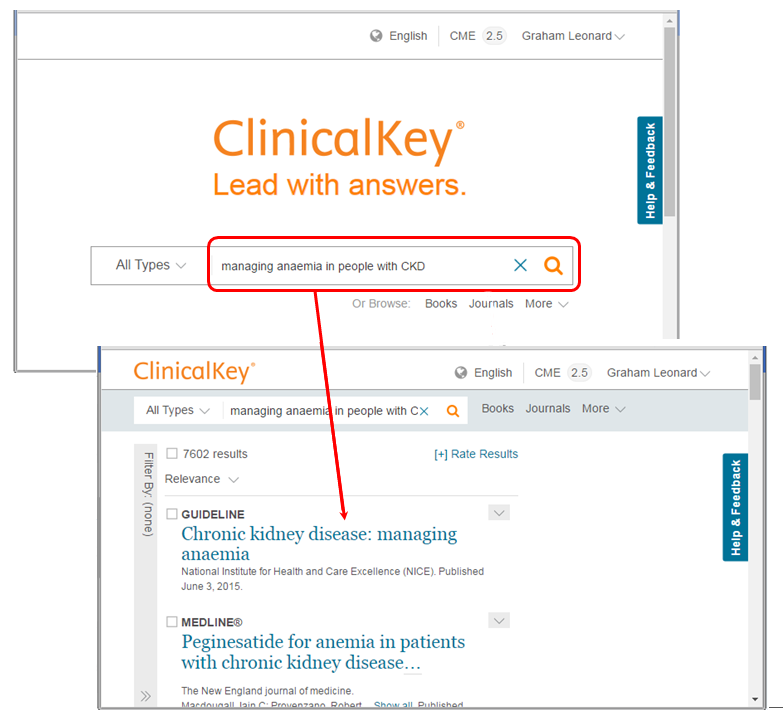
How did you find using the syndication service and API?
"The NICE syndication service provides a quality assured process to deliver digital content - an important requirement for robust and efficient data retrieval. The API, which is based on web services and REST principles, was a good fit with our solution architecture.
"Developers found the API intuitive and straightforward to use. The 'Guidance Data Service' is used via the API to transfer guidelines content into ClinicalKey. An import using the REST service, which returns XML formatted data, is fetched daily via the API. This augments the existing content within ClinicalKey's content database.
"The data returned from the API allows accurate indexing and categorisation of the guidelines within ClinicalKey, resulting in an excellent search and viewing experience for the end user."
How does NICE content benefit your users and business?
"Having NICE guidelines in our clinical solutions is extremely beneficial to users looking for evidence based recommendations relevant to their healthcare setting.
"Healthcare professionals can embed clinical decision support based on trusted recommendations directly into their workflow, supporting their decision making process at point of care.
"NICE guidelines extend and complement our existing evidence based offerings. They make sure our solutions meet the needs of clinicians and decision makers in the NHS and other healthcare bodies in the UK."
"Demand for NICE guidelines in ClinicalKey is not just limited to the UK; Elsevier's global customer base can now benefit from access to these guidelines. Usage is expected to be high outside the UK due to NICE being internationally recognised as a contributor to better health outcomes across the world."