Saving babies' hearing: how a world-first rapid genetic test is transforming neonatal care
Learn how NICE's healthtech guidance helped bring life-changing genetic testing to neonatal units across the UK, saving 20 babies' hearing so far with potential to prevent hearing loss in 200 babies annually.
Professor Bill Newman
Consultant in genomic medicine at Manchester University NHS Foundation Trust
I can vividly remember when baby number 11 in our first PALOH study tested positive. You could feel the impact ripple through the neonatal unit. The nurses knew they had just saved that baby's hearing. It was tangible, immediate and deeply meaningful.
Professor Bill Newman, consultant in genomic medicine at Manchester University NHS Foundation Trust
That moment encapsulates why rapid genetic testing in neonatal care matters. It galvanised the entire team and reinforced our commitment to making the test part of every baby's care.
Understanding the challenge
Every year in England and Wales, around 100,000 newborn babies receive the antibiotic gentamicin to treat suspected bacterial infections. It's a highly effective, first-line treatment that has saved countless lives. However, for approximately 1 in 500 babies (around 1,249 each year) who carry a specific genetic variant called m.1555A>G, gentamicin can cause profound and irreversible hearing loss. The impact is intense, affecting quality of life and requiring extensive NHS interventions such as NICE-approved cochlear implants.
Alternative antibiotics exist and are equally effective, but they cannot be used more widely due to antimicrobial resistance concerns. Babies admitted urgently to neonatal intensive care need antibiotics within an hour of admission. We needed a way to identify at-risk babies quickly, within this critical 'golden hour' since traditional laboratory testing takes several days.
From laboratory innovation to clinical reality
In 2014, I attended a local talk where a manufacturer was presenting their point-of-care testing technology. They were thinking about applications in agriculture and infection detection in developing countries, but I immediately saw the potential for rapid genetic testing in medical care.
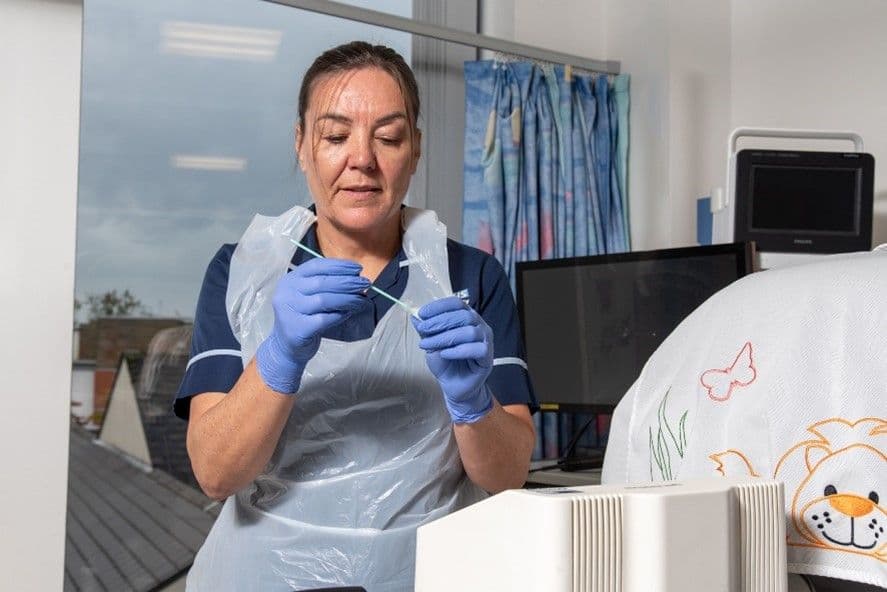
With funding from the Royal National Institute for Deaf People, we co-developed a prototype. A simple cheek swab, processed through the device, could detect the m.1555A>G variant in just 25 minutes.
However, laboratory success is one thing; clinical implementation is quite another. We launched the Pharmacogenetics to Avoid Loss of Hearing (PALOH) study to see if the test could work in frontline care. The research was funded by the National Institute for Health and Care Research's (NIHR) Invention for Innovation scheme.
Starting in Manchester and Liverpool in 2020, we tested approximately 750 babies. Three tested positive and received alternative antibiotics, avoiding life-changing hearing loss. Crucially, the test did not delay treatment beyond the ‘golden hour’. Our health economic analysis showed compelling value: at around £130 per test, compared to £65,000 for bilateral cochlear implants in the first year alone, we estimate that the test could save the NHS £5 to £7 million annually.
NICE's role in accelerating innovation
NICE’s healthtech guidance evaluates medical devices, diagnostics and digital products to assess how well they work and if they offer good value.
For promising new technologies, NICE can recommend early use while more evidence is gathered. This means the NHS can start using them straightaway, but researchers continue collecting data to answer any remaining questions. After about 3 years, NICE reviews all the evidence and decides whether the technology should be used routinely across the NHS.
This approach ensures promising innovations are not held back by evidence gaps, while maintaining the rigour needed for safe, effective implementation.
Compelling data
In March 2023, NICE published healthtech guidance for early use on the device. NICE’s independent committee reviewed our PALOH study results and conditionally recommended the technology while further evidence is generated.
The committee’s feedback was constructive and demonstrated NICE's commitment to rigorous, evidence-based evaluation. They recognised the promise of our work while rightly identifying opportunities to strengthen the evidence base. This felt like exactly the right approach. It gave us a clear pathway forward while allowing the technology to begin making a difference immediately.
Professor Bill Newman, consultant in genomic medicine at Manchester University NHS Foundation Trust
Building the case for national adoption
NICE's guidance created clear pathways for progress. It helped secure funding from NHS Greater Manchester Integrated Care Board and Health Innovation Manchester for implementation across the region’s 8 neonatal units. NICE also worked with NIHR and the Office for Life Sciences to make £1.4 million available for a UK-wide trial. This gave us a clear roadmap for generating the evidence NICE had outlined in its evidence generation plan.
We launched an expanded study (PALOH-UK) in November 2024 across 14 neonatal units in Greater Manchester, Brighton, Cardiff, North Wales, Glasgow, Belfast and Norwich. We chose a range of diverse settings including large intensive care units, small special care baby units, and different demographics across all 4 UK nations.
We expect the results to be ready by October 2026. The study data will then inform NICE's full assessment for routine adoption across the NHS.
Real impact, real lives
To date, we've tested 8,000 babies and identified 20 with the genetic variant. Behind each positive result is a baby like Ginny whose hearing has been preserved and a family spared profound challenges. Because the variant passes through the maternal line, identifying one baby also protects their mother, siblings, and extended family members who should avoid gentamicin.
As someone who has worked in genomic medicine for many years, seeing research translate into preventing hearing loss in babies has been so rewarding. It’s this kind of impact that makes a career in medical research so worthwhile. That's a feeling I'm immensely grateful for.
Without NICE's healthtech guidance and the coordinated support from NIHR, the Office for Life Sciences and Health Innovation Manchester, this technology might have remained confined to a single hospital. Instead, we now have a clear pathway to national adoption. The prospect that every at-risk baby across the UK could access this life-changing test is genuinely exciting.
Beyond the personal satisfaction, the project has demonstrated real progress on multiple fronts. The test failure rate has dropped from 15% in our initial study to 5% today, making the technology increasingly reliable. International interest is also growing, with several countries now exploring adoption of this UK-developed innovation.
Discover what support looks like
If you're an NHS decision maker considering healthtech solutions for your trust or integrated care board, explore NICE's healthtech guidance to understand how evidence-based recommendations can support confident adoption decisions.